
How to Grow Your IT Career in a Changing Tech Industry
To grow your IT career, pick a target role, build skills in a high-demand area (cloud, cybersecurity, data or AI), prove them with hands-on projects, add one certification that matches the role, and build visibility through networking and measurable results. Most people can start seeing progress in a 90-day cycle.
Ten years ago, a solid IT career path was easy to describe. You learned one stack, earned a certification, and climbed the ladder. Today, cloud platforms, AI-assisted development, and rising security demands rewrite job descriptions every year. Demand for technology talent is still strong, but IT career growth now depends less on how long you have been in a role and more on how deliberately you build, prove, and share your skills.
This guide explains what is driving IT career growth today and gives you practical steps to move forward, whether you are preparing for a first role or planning a senior-level pivot.
The 3 Pillars of IT Career Growth
IT career growth is the steady progression of your skills, responsibilities, and professional value in the technology industry. It can mean a promotion, a move into a specialization such as cloud engineering or cybersecurity, a step into leadership, or a better role at a new company.
It is rarely a straight line. It rests on three things:
Relevant Skills
Skills that match what employers need now.
Verifiable Experience
Proof that you can apply those skills.
Professional Visibility
So the right people know your results.
Why IT Career Growth Looks Different Today
The market is growing, but it is also reshuffling. The U.S. Bureau of Labor Statistics (BLS) projects that computer and information technology occupations will grow much faster than the average for all occupations from 2024 to 2034. It expects about 317,700 openings a year, and the median annual wage for these jobs was $105,990 in May 2024.
Growth is uneven across roles. BLS projections for 2024 to 2034 include:
Software developers, QA analysts, and testers are projected to grow 15%, compared with 3% for all occupations. Not every role is expanding, though. BLS projects a decline for computer programmers.
The World Economic Forum’s Future of Jobs Report 2025 points the same way. It ranks AI and big data, networks and cybersecurity, and technological literacy as the three fastest-growing skills through 2030. It also stresses that resilience, flexibility, and curiosity remain critical.
The message is clear: narrow, repetitive roles are the most exposed, while roles that combine technical depth with adaptability are in demand.
IT Career Paths: A Typical Progression
There is no single IT career ladder, and job titles vary from company to company. Most paths follow the same pattern, though: start in a support or junior role, build a specialization, then choose between technical depth and leadership. Here are four common examples.
This path often branches into data science or machine learning engineering. Data scientists focus on analysis and predictive models, while ML engineers focus on building and deploying those models in production. If you are weighing the two, see machine learning engineer vs data scientist.
These paths overlap, and people often cross between them. A systems administrator can move into cloud engineering, and a data analyst can move into data engineering or data science. The 8 ways below work on any of these routes.
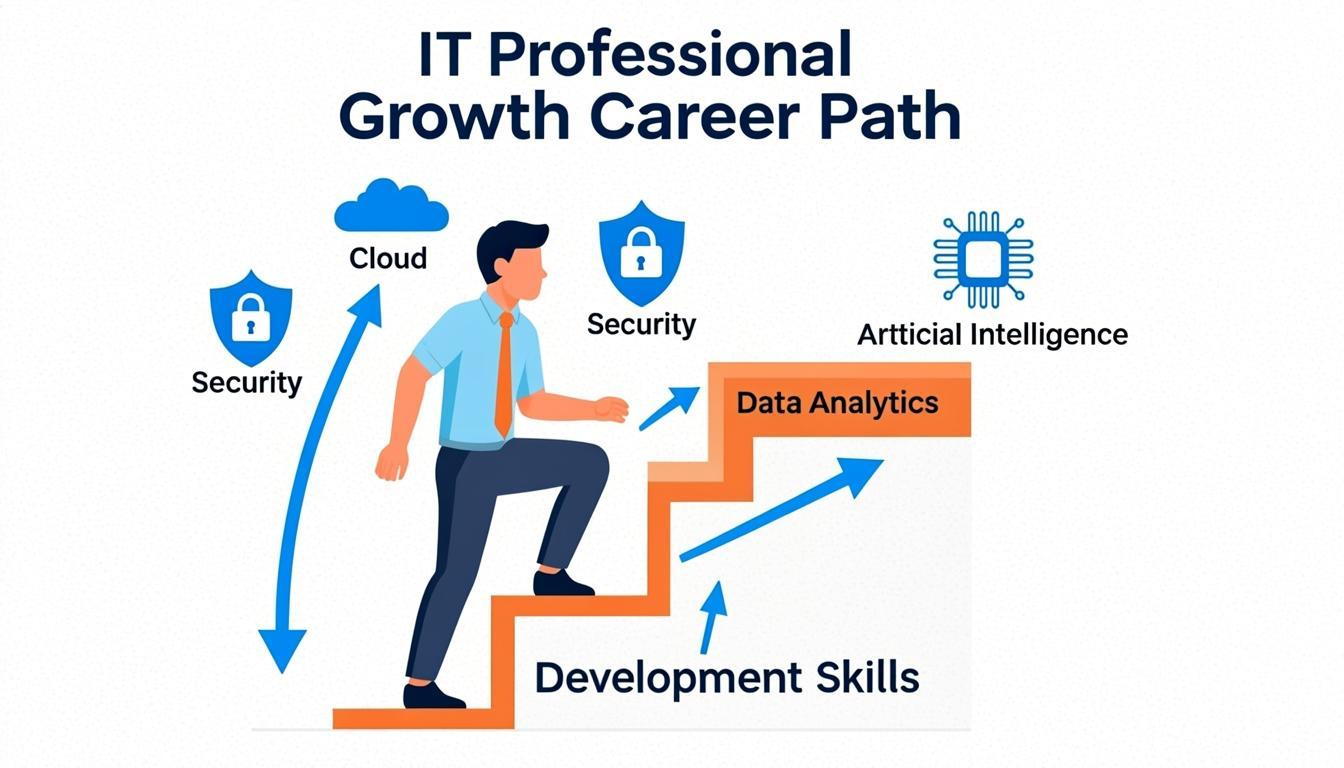 IT career growth rewards professionals who learn continuously, specialize with
intent, and can show results.
8 Ways to Grow Your IT Career
Drifting from project to project rarely compounds. Pick a target role two to three years out, such as cloud architect, DevSecOps engineer, data engineer, or engineering manager.
Then read ten current job postings for that role and list the skills that appear again and again. That list becomes your learning roadmap.
You do not need to chase every trend. Go deep in one area and stay familiar with the others. This “T-shaped” profile is the strongest base for long-term IT career growth. If your chosen area involves coding, pair it with one or two core languages. This guide to programming languages worth learning in 2026 explains where Python, TypeScript, Go and Rust fit.
Four areas worth considering:
- Cloud & DevOps: infrastructure as code, CI/CD, containers, and platforms such as AWS, Azure, Google Cloud, Docker, Kubernetes, and Terraform
- Cybersecurity: identity and access management, zero trust, vulnerability management, and incident response
- Data & AI: SQL, Python, data pipelines, and platforms such as Databricks and Snowflake
- Software engineering: system design, API design, testing, secure coding, and languages such as TypeScript, Go, or Rust
Certifications help most when they match a specific target role. They can open interviews and validate a career pivot, but they rarely replace experience.
Common choices by path:
- Cloud: AWS Certified Solutions Architect, Microsoft Azure Administrator, Google Professional Cloud Architect
- Containers & DevOps: Certified Kubernetes Administrator (CKA), HashiCorp Terraform Associate
- Security: CompTIA Security+ for foundations, CISSP for experienced practitioners
- Data: Databricks and cloud data engineering certifications
Before you pay for an exam, check whether the credential appears in postings for the job you want. If it does not, skip it.
Employers hire for what you can do. A short, well-documented project often persuades more than another course badge.
Good proof of skill includes:
- Deploying a small application on a cloud platform with Terraform and documenting the architecture
- Contributing to an open-source project
- Building a data pipeline from a public dataset and publishing the code and write-up
- Volunteering for stretch work at your job, such as a service migration or an incident review
Technical skills get you hired. Communication and judgment get you promoted.
Practice explaining technical trade-offs to non-technical colleagues, writing clear documentation, and giving constructive code review feedback. Tie your work to outcomes such as cost savings, uptime, or faster delivery. Saying “this migration cut deployment time and infrastructure cost” is far stronger than listing the tools you used.
Many opportunities arrive through people rather than job boards. Keep your LinkedIn profile focused on outcomes, share what you learn in short posts, and join technology communities. Attend meetups or virtual conferences, and stay in touch with former colleagues and managers.
A mentor can also save you months of trial and error, even if you speak only once a quarter.
AI coding assistants, AI-enabled observability platforms, and automated security tools are now part of daily IT work. Professionals benefit when they use these tools to move faster while still reviewing the output critically. For a closer look at tools and use cases across code review, testing, and DevOps, see how AI is changing software engineering.
Start with these practical skills:
- Prompt-driven workflows: writing clear prompts for code, tests, documentation, and incident summaries
- Critical review: checking AI-generated code for bugs, insecure patterns, and outdated libraries before it ships
- AI in your specialization: for example, AI-assisted testing for QA, anomaly detection for cloud and DevOps, and automated vulnerability scanning for security
- Governance basics: data privacy, licensing, and company policy on AI-generated code
Responsible AI use is quickly becoming a baseline expectation. Keep building core skills such as system design and debugging, so AI speeds up your work without replacing your judgment.
Most IT careers eventually fork. Neither path is better than the other.
The technical path leads toward senior engineer, principal engineer, or architect roles. Your impact comes from depth and design decisions.
The leadership path leads toward team lead, engineering manager, or director roles. Your impact comes from developing people and aligning teams.
To test the leadership route, try low-risk steps such as mentoring a junior colleague or coordinating a project. Then choose based on what energizes you.
IT Career Growth by Career Stage
Early-Career (Under 3 Years)
Aim for breadth with proof. Employers want to see that you can apply what you have learned.
- Master the fundamentals: networking basics, Linux, Git, one programming language, and SQL
- Build two or three portfolio projects that mirror real work
- Earn one entry-level certification aligned with your target role
- Look for internships, contract roles, or junior positions where you can learn from experienced engineers
- Ask for feedback often and track your accomplishments from the first month
Mid-Career (3 to 8 Years)
You are no longer proving that you can do the work. You are showing that you can own results.
- Own something end to end. Take responsibility for a service, pipeline, or migration, not just individual tickets.
- Go deeper in one area. Choose a specialization such as cloud, security, or data instead of staying a generalist.
- Start mentoring. Helping a junior colleague builds the leadership evidence that senior roles require.
- Quantify your impact. Track outcomes such as uptime, cost savings, or faster deployments, and use them in your resume and reviews.
Experienced (8+ Years)
Your biggest risk is a skills plateau, where deep expertise in a legacy stack slowly loses market value.
- Refresh your stack deliberately. A systems administrator can move toward cloud and infrastructure as code, a database administrator toward cloud data platforms, and a QA engineer toward test automation and reliability engineering.
- Move from tasks to strategy. Design solutions, set standards, and advise on risk and cost.
- Mentor others and consider specializing. Security architecture, data governance, and platform engineering all reward seasoned judgment.
Contract and consulting work can also help. It exposes you to varied environments and technologies in a short time.
Common Mistakes That Slow IT Career Growth
Watch out for these five habits:
- Collecting certifications without applying them. Pair each one with a project.
- Chasing every trend. Depth in two or three tools beats shallow exposure to ten.
- Staying invisible. Great work that nobody sees rarely leads to promotion.
- Ignoring soft skills. Stalled promotions are often communication problems.
- Waiting for permission. Create your own stretch work instead.
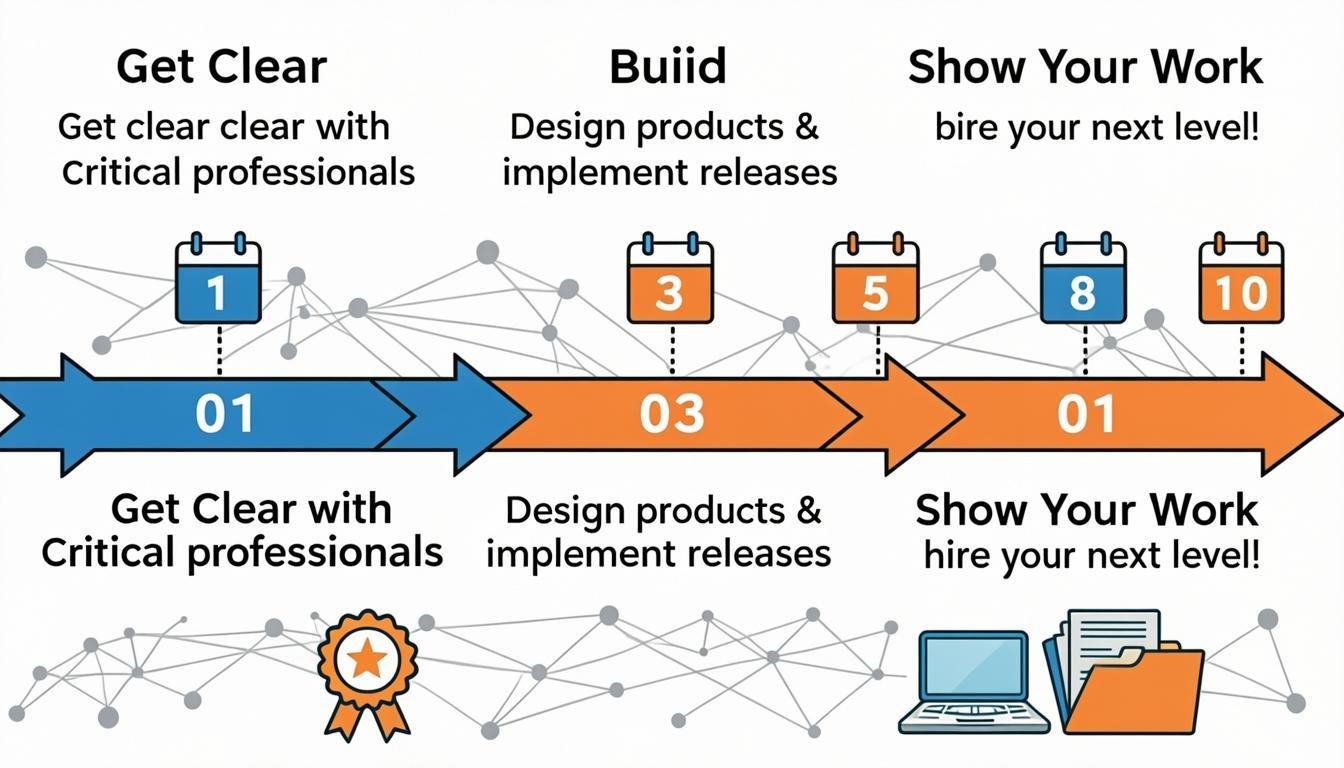 Small, steady steps compound faster than occasional bursts of effort — repeat
this cycle every quarter.
Your 90-Day IT Career Roadmap
If you are not sure where to start, use this plan.
Define your direction
Define your target role, review current job postings for it, and identify your top three skill gaps.
Start learning and doing
Start one focused learning path and complete one hands-on project. Begin certification study if it fits your goal.
Publish and connect
Publish your project and add measurable results to your resume and LinkedIn profile. Ask your manager for a growth conversation, and reach out to five people in your target field.
Repeat this cycle every quarter. Small, steady steps compound faster than occasional bursts of effort.
Frequently Asked Questions
Define a target role, build skills in a high-demand area such as cloud, cybersecurity, or data, prove them with hands-on projects, add a certification that matches your goal, and build visibility through networking and a strong professional profile.
The World Economic Forum’s Future of Jobs Report 2025 ranks AI and big data, networks and cybersecurity, and technological literacy as the fastest-growing skills through 2030. Cloud and DevOps skills are also consistently requested by employers.
They are worth it when they match your target role and are backed by practical experience. A certification that appears in job postings for your desired position can help you get interviews. One with no link to your goals adds cost without much benefit.
Choose based on where you want your impact to come from. Technical paths reward depth and design expertise, while management paths reward people development and cross-team alignment. Mentoring or leading a small project is a low-risk way to test the leadership route.
Conclusion
IT career growth in a changing tech industry rewards professionals who learn continuously, specialize with intent, and can show results.
AI, cloud, and cybersecurity will keep shifting job requirements, but the fundamentals stay the same: build relevant skills, prove them through real work, communicate your value, and stay connected to people and opportunities.
Start this week with one clear target role and the 90-day IT career roadmap. Small, steady steps compound faster than occasional bursts of effort.
Building your IT career, or your IT team? Vyzer Solutions helps businesses with DevOps, cybersecurity, data analytics, and cloud services.
Explore Our IT Services or Contact Our Team