V Y Z E R
>

How AI Is Transforming Software Engineering

0 Comments

How AI Is Transforming Software Engineering

Discover how AI is transforming software engineering - from code generation to testing and DevOps. Learn the tools, trends, and strategies redefining software development.

Introduction: The AI Revolution in Software Engineering

Software engineering has always evolved - from punch cards to cloud-native architectures. But the emergence of artificial intelligence in development workflows represents one of the most profound shifts the industry has ever seen.

Today, AI in software engineering is not merely a buzzword. It is a practical, measurable force reshaping how teams write, test, review, and deploy code. From intelligent code generation tools like GitHub Copilot to AI-driven testing frameworks and machine-learning-powered DevOps pipelines, every stage of the software development lifecycle (SDLC) is being reimagined.
What Does AI Actually Do in Software Development?

Understanding the role of AI in software development requires moving beyond hype and into practical application. AI does not replace software engineers - it augments their capabilities, automating the repetitive, accelerating the complex, and enhancing the quality of the overall output.

Here are the key areas where AI is making a direct impact:

1. Intelligent Code Generation

AI models like OpenAI Codex and tools built on large language models (LLMs) can now generate functional code snippets, complete functions, or even entire modules from natural language prompts. GitHub Copilot, powered by Codex, suggests context-aware completions as developers type.

Key Note: AI code generation tools do not just autocomplete - they understand context, programming patterns, and logic structures to generate semantically meaningful code.

2. Automated Code Review and Quality Assurance

Manual code reviews are time-consuming and prone to human oversight. AI-powered code review tools such as DeepCode (acquired by Snyk), Codiga, and SonarQube's AI features scan codebases in real time, identifying bugs, security vulnerabilities, and style inconsistencies before they ever reach production.

These tools learn from millions of open-source repositories, enabling them to flag subtle errors that even senior engineers might overlook.

3. AI-Powered Testing and Bug Detection

Testing is one of the most labour-intensive phases of the SDLC. AI transforms it by:

Auto-generating unit tests and edge-case scenarios based on existing code

Predicting which areas of code are most likely to break - enabling smarter test prioritization

Using visual AI to detect UI regressions in web and mobile applications

Performing continuous, intelligent regression testing without manual scripting

4. Natural Language Programming and Prompt-Driven Development

Emerging paradigms like natural language programming allow developers to describe requirements in plain English and have AI generate working prototypes. Tools like Cursor, Replit AI, and Claude Code are blurring the line between writing and building software.

This democratises development - enabling domain experts without deep coding backgrounds to contribute meaningfully to software creation.

AI Across Every Stage of the Software Development Lifecycle

One of the most remarkable aspects of AI in software engineering is that its benefits are not confined to a single phase. The entire SDLC - from planning to post-deployment monitoring - is being enhanced.

SDLC Stage AI Application
Requirements Analysis NLP tools extract and structure requirements from stakeholder documents
System Design AI recommends architecture patterns based on project scope and constraints
Code Development Code generation, inline documentation, and smart autocomplete
Code Review Automated quality checks, vulnerability scanning, style enforcement
Testing Test case generation, mutation testing, visual regression analysis
Deployment Intelligent CI/CD pipelines, deployment risk prediction
Monitoring & Ops Anomaly detection, incident prediction, auto-remediation

AI-Driven DevOps: Smarter Pipelines, Faster Releases

DevOps has always been about velocity and reliability. AI elevates both. Machine learning algorithms embedded in CI/CD pipelines analyse historical build and deployment data to:

Predict which commits are likely to introduce failures

Automatically roll back risky deployments before they affect end users

Optimise cloud resource allocation based on traffic patterns

Surface intelligent alerts that reduce alert fatigue among operations teams

Platforms such as Harness and LaunchDarkly have embedded AI features that enable feature flag automation and deployment intelligence - helping teams release faster with fewer incidents.

Industry Insight: According to the DORA 2024 State of DevOps Report, elite-performing engineering teams are 4x more likely to use AI-assisted automation in their delivery pipelines than low-performing teams.

Top AI Tools Transforming Software Engineering Today

The AI tool ecosystem for software engineers has exploded. Here is a curated breakdown of tools driving real-world productivity gains:

Code Assistance & Generation
Testing & QA
Security & Code Review
Monitoring & Incident Management

GitHub Copilot

LLM-powered inline code suggestions inside VS Code, JetBrains, and more

Cursor

An AI-native IDE built for pair-programming with LLMs

Amazon CodeWhisperer

AWS-native code generator with security scanning

Tabnine

Enterprise-focused AI assistant with local model support for data privacy

Diffblue Cover

Generates Java unit tests automatically from existing code

Testim

AI-based test automation with self-healing test scripts

Applitools Eyes

Visual AI for cross-browser UI testing

Snyk

AI-assisted vulnerability scanning across code, containers, and infrastructure

SonarQube

Static analysis with AI-powered quality gates

Semgrep

Pattern-based static analysis with ML-assisted rules

Datadog AI

Anomaly detection and predictive alerting for production systems

PagerDuty AIOps

Reduces noise, auto-groups alerts, and predicts incidents

Future of AI in DevOps

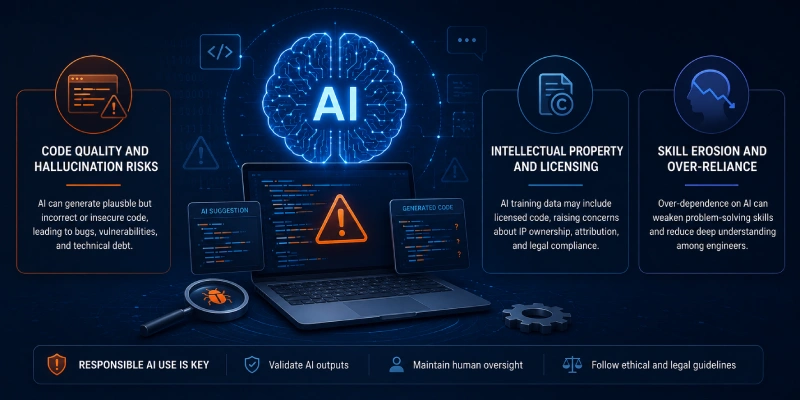
Challenges and Ethical Considerations in AI-Assisted Engineering

AI in software engineering is powerful - but it is not without challenges. A balanced perspective demands acknowledging the risks alongside the opportunities.

Code Quality and Hallucination Risks

AI-generated code can introduce subtle bugs, insecure patterns, or outdated library usage. Engineers must critically review AI suggestions rather than blindly accepting them. Studies have shown that unchecked AI-generated code carries a higher rate of security vulnerabilities than manually written code.

Intellectual Property and Licensing

AI tools trained on open-source code raise legitimate questions about copyright and licensing. Teams must establish clear policies around AI-generated code ownership before deploying to production.

Skill Erosion and Over-Reliance

There is a genuine risk that over-reliance on AI tools may erode foundational engineering skills - particularly among early-career developers. The key is to use AI as an augmentation tool while continuing to build core competencies in algorithms, system design, and debugging.

Best Practice Framework: Treat AI-generated code the same way you would code from a junior developer: review it thoroughly, test it rigorously, and never ship it without understanding what it does.

The Future of AI in Software Engineering: What Comes Next?

The trajectory of AI in software development points to even deeper integration. Here is what the next 3–5 years looks like:

Autonomous Agents

AI systems capable of independently planning and executing multi-step development tasks - writing code, running tests, and iterating based on feedback loops.

AI Architects

Systems that recommend and validate system architecture decisions based on performance data, team constraints, and business requirements.

Self-Healing Software

Applications that detect runtime errors and auto-deploy patches without human intervention, powered by reinforcement learning models.

Low-Code/No-Code Intelligence

AI enabling non-technical stakeholders to build complex applications through conversational interfaces.

Domain-Specific LLMs

Fine-tuned models trained exclusively on enterprise codebases - delivering deeply contextual suggestions aligned with proprietary coding standards.

Frequently Asked Questions (FAQs)

Will AI replace software engineers?

No. AI augments software engineers rather than replacing them. The demand for human judgment, system thinking, creativity, and ethical oversight in software development remains irreplaceable. AI handles repetitive, low-level tasks, freeing engineers to focus on higher-order problem-solving.

What is the best AI tool for software development in 2025?

GitHub Copilot remains the most widely adopted AI coding assistant, with deep IDE integration and broad language support. However, the best tool depends on your workflow - Cursor for AI-native development, Tabnine for enterprise privacy needs, and Amazon CodeWhisperer for AWS-centric teams.

Is AI-generated code safe to use in production?

AI-generated code should always be reviewed, tested, and validated before production deployment. While AI tools improve productivity, they can introduce security vulnerabilities or incorrect logic. Always run AI-generated code through standard code review and testing processes.

How does AI improve software testing?

AI improves testing by automatically generating test cases, predicting failure-prone code paths, performing visual regression testing, and enabling continuous self-healing tests that adapt as the codebase evolves - dramatically reducing manual testing effort.

How can I learn to use AI tools as a software engineer?

Start by integrating GitHub Copilot or Cursor into your existing IDE. Explore platforms like Coursera, Pluralsight, and the official documentation of tools like Snyk, GitHub Copilot, and AWS CodeWhisperer. Practice building real projects with AI assistance while continuing to deepen your core engineering fundamentals.

What does GEO mean in the context of this content?

GEO stands for Generative Engine Optimisation - structuring content to be clearly understood and accurately cited by AI-powered search and answer engines like ChatGPT, Perplexity, and Google's AI Overviews. This blog follows GEO best practices through direct answers, structured FAQs, and factual, citation-ready content.

Conclusion: Embracing AI as a Force Multiplier

AI is not coming for software engineers. It is coming for the inefficiencies that slow them down. The organisations and individuals who embrace AI tools thoughtfully - understanding both their power and their limitations - will define the next generation of software engineering excellence.

From intelligent code generation and automated testing to AI-powered DevOps and predictive monitoring, the transformation is already underway. The question is not whether to adopt AI in your development workflow - it is how fast and how wisely you will do so.

The engineers who treat AI as a collaborator, invest in understanding its outputs critically, and continue building deep technical expertise will be the ones who thrive in this new era.

Ready to Future-Proof Your Engineering Career?

AI is rewriting the rules of software engineering. Don't get left behind. Explore tools, strategies, and insights designed to help you stay ahead.

Discover more services.
Related Tags:
Social Share:

Leave A Comment

Company
Office

Copyright © Vyzer Solutions All rights reserved