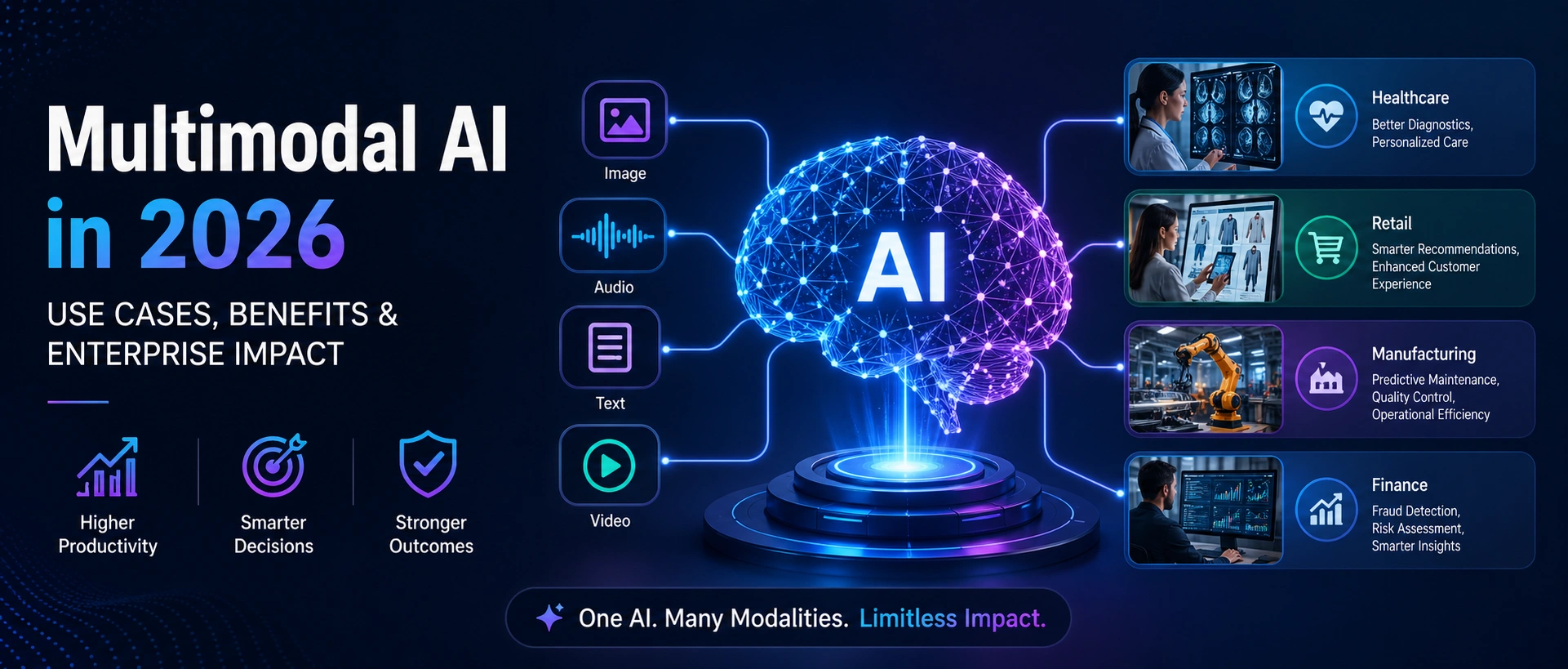
Multimodal AI is rapidly becoming the foundation of modern enterprise technology. By processing multiple data types simultaneously — text, images, audio, and structured data — these systems are unlocking faster decision-making, improved accuracy, and scalable automation across industries.
In 2026, multimodal AI is no longer experimental. It is actively transforming healthcare, finance, retail, and manufacturing by enabling intelligent systems to understand and act on complex, real-world scenarios that single-input AI models simply cannot handle.
This guide walks you through what multimodal AI is, why it matters now, how top industries are deploying it, and exactly how your organization can start adopting it today.
Section 02
What Is Multimodal AI?
Multimodal AI refers to artificial intelligence systems designed to process and analyse multiple data types simultaneously. Unlike traditional models limited to a single input — text only, or images only — multimodal AI integrates diverse data streams to deliver significantly deeper insights and more accurate results.
A practical example: a multimodal system can simultaneously analyse customer reviews (text), product images, and historical purchase behaviour to generate highly personalised recommendations. No single-input model can replicate this depth.
Multi-Data Processing
Processes text, images, audio, video, and structured data in one unified model
Rich Context
Understands rich context across different data types at the same time
Combined Outputs
Generates outputs combining insights from multiple modalities
Continuous Learning
Continuously learns and adapts from varied, real-world data inputs
Section 03
Why It Matters in 2026
Businesses today operate in data-rich environments where decisions depend on synthesizing information from many sources at once. Multimodal AI connects these data points, enabling organizations to act faster and more accurately than ever before.
Companies adopting enterprise AI solutions are already reporting measurable gains in operational efficiency, customer experience, and competitive intelligence. The organizations that wait risk a compounding disadvantage that becomes increasingly difficult to close.
Business Outcomes
40% faster decision-making cycles
Significant reduction in manual costs
Improved customer satisfaction scores
Stronger fraud detection rates
Competitive Advantages
Real-time, multi-source intelligence
Scalable automation across departments
Earlier identification of market shifts
Higher ROI on AI investment
Section 04
Use Cases Across Industries
Multimodal AI use cases now span virtually every major industry. Here is how leading sectors are deploying this technology to generate real business value.
Manufacturing
AI systems integrate sensor data, machine logs, and visual inspections to predict equipment failures before they happen. This predictive maintenance model reduces unplanned downtime and extends asset lifecycles.
Retail & E-Commerce
Retailers combine browsing behavior, purchase history, and product imagery to deliver personalized recommendations that drive higher conversion rates and long-term customer loyalty.
Healthcare
Providers combine medical imaging, patient records, lab results, and clinical notes to assist clinicians in faster, more accurate diagnoses and early disease detection.
Finance & Banking
Institutions detect fraud by simultaneously analyzing transaction patterns, user behavior, device signals, and documentation — catching anomalies that single-input models routinely miss.
Logistics & Supply Chain
AI optimizes global supply chains using real-time inputs from GPS systems, warehouse sensors, weather data, and demand forecasts — resulting in smarter routing, fewer delays, and meaningfully lower operational costs.
Section 05
Multimodal AI vs. Traditional AI
Understanding this distinction is critical for enterprise AI strategy. Traditional models are designed for a single data type — a text classifier or an image recognizer. Within that narrow scope they perform well. But they cannot combine context across data types, which severely limits their usefulness in real-world business scenarios.
Capability
Traditional AI
Multimodal AI
Data Types
Single input only
Text, image, audio, video
Context Depth
Shallow, narrow
Deep, cross-modal context
Business Use Cases
Limited scope
Broad, complex scenarios
Decision Accuracy
Moderate
Significantly higher
Automation Level
Task-specific
End-to-end workflow
Section 06
The Rise of Agentic AI
Agentic AI represents the next frontier of enterprise automation. Building on multimodal foundations, agentic systems do not just analyze data — they act on it autonomously. These systems execute multi-step workflows, optimize processes in real time, and respond dynamically to changing conditions without requiring human sign-off at each step.
Common agentic AI applications in 2026:
Automated customer service resolution and intelligent escalation routing
Autonomous inventory management, demand sensing, and restocking
Self-optimizing marketing campaign execution and budget allocation
Proactive compliance monitoring, alerting, and automated reporting
Section 07
How to Implement Multimodal AI
Adopting multimodal AI does not require overhauling your entire technology stack at once. A phased, strategic approach delivers the fastest return on investment with the least organizational disruption.
6-Step Implementation Roadmap
1
Identify High-Impact Problems
Identify high-impact business problems that involve multiple data sources
2
Audit Existing Data Assets
Audit existing data assets for quality, accessibility, and integration readiness
3
Define Clear KPIs
Define clear KPIs and measurable success criteria before beginning any pilot
4
Launch 90-Day Pilot
Launch a focused 90-day pilot project to validate ROI and refine the approach
5
Build Internal AI Literacy
Build internal AI literacy and align cross-functional stakeholders around outcomes
6
Scale Successfully
Scale successful pilots systematically across the broader organization
Partnering with an experienced enterprise AI solutions provider can accelerate every stage of this journey — from strategy, architecture, and data engineering through production deployment and ongoing optimization.
Section 08
Conclusion
Multimodal AI is redefining how enterprises operate — enabling smarter, faster, and more accurate decisions across every function and industry. The performance gap between AI-enabled organizations and those still relying on legacy approaches is widening every quarter.
Organizations that begin their multimodal AI journey now are building durable competitive advantages that will compound over time. The technology is mature, the use cases are proven, and the ROI is measurable. The only question is how quickly you move.
Ready to get started?
Transform Your Business with AI Today
Discover how our enterprise AI solutions can help you reduce costs, improve decision-making, and accelerate growth. Our team of AI specialists is ready to build a tailored roadmap for your organization.
Multimodal AI is an artificial intelligence system that simultaneously processes multiple data types — such as text, images, audio, and structured data — to generate richer insights and more accurate outputs than any single-input model can produce.
What are the key benefits of multimodal AI for businesses?
It improves decision accuracy, accelerates automated workflows, reduces operational costs, and enables more personalized customer experiences. It also strengthens fraud detection, risk assessment, and compliance monitoring.
Which industries benefit most from multimodal AI?
Healthcare, retail, financial services, manufacturing, and logistics are seeing the strongest returns today. However, any industry that relies on complex, multi-source data analysis can benefit significantly from this technology.
How does multimodal AI differ from traditional AI?
Traditional AI models handle a single data type, limiting contextual understanding. Multimodal AI integrates multiple data sources into one unified model, enabling it to recognize complex patterns and deliver context-aware outcomes that are simply not possible with single-input systems.
What is agentic AI, and how does it relate to multimodal AI?
Agentic AI builds on multimodal capabilities by not only understanding data but also taking autonomous actions based on that analysis. Agentic systems execute multi-step tasks, adapt in real time, and operate independently — making them ideal for enterprise automation at scale.
How do I get started with multimodal AI in my organization?
Start by identifying the business problem you want to solve, then assess your current data infrastructure. Define success metrics, run a contained 90-day pilot, and work with a trusted AI partner to build a scalable roadmap tailored to your specific goals and constraints.